
Tonight at 8:30
Coward archivist Julie Gambling on the history of Still Life’s original production.
-
![]()
Original Programme, West End (1936)
-
![]()
Original Programme, West End (1936)
-
![]()
Original Programme, West End (1936)
-
![]()
Original Programme, West End (1936)
-
![]()
Original Programme, West End (1936)
-
![]()
Original Programme, West End (1936)
-
![]()
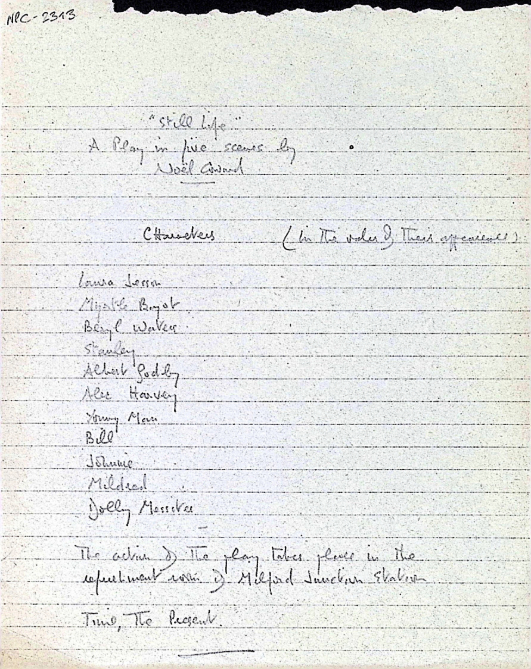
Handwritten script notes by Coward (1935)
-
![]()
Handwritten script notes by Coward (1935)

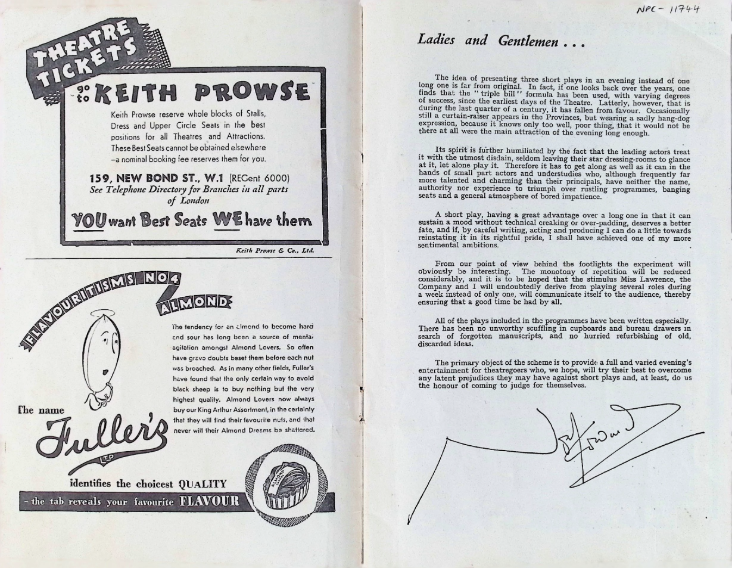
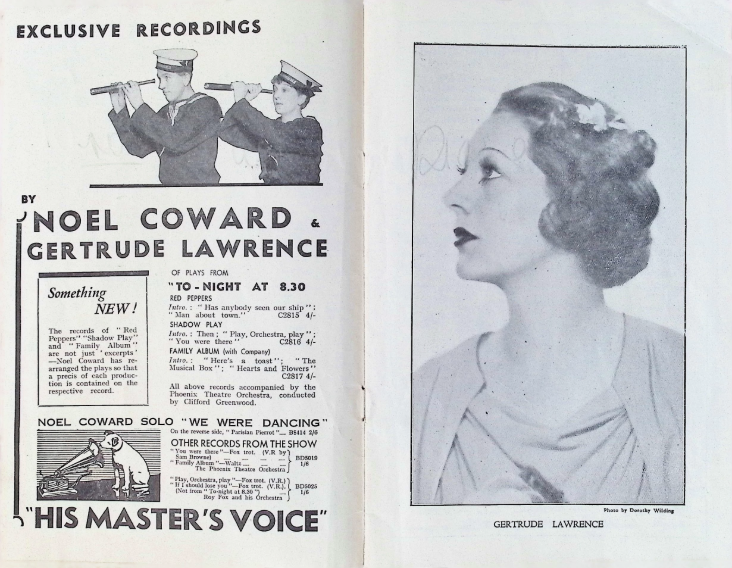
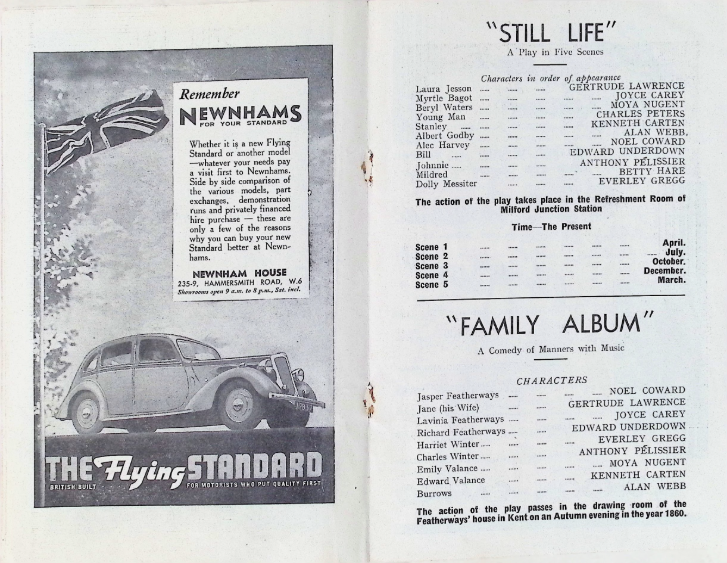

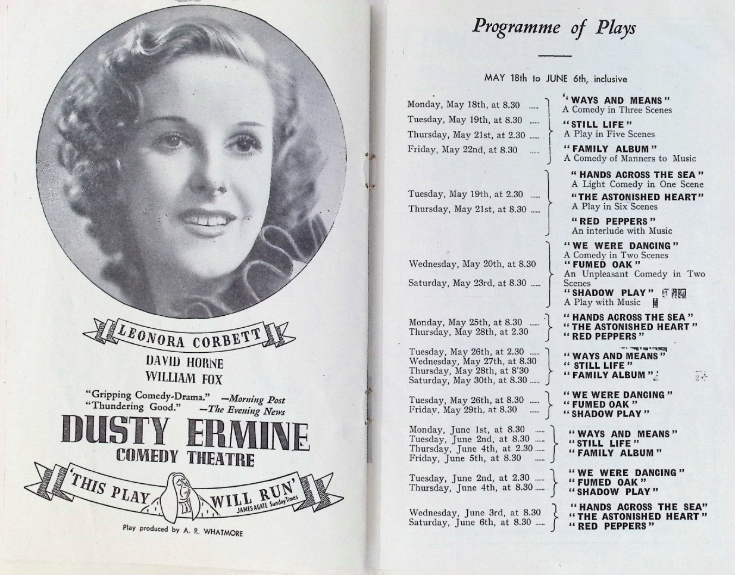

Noël Coward collected play titles. His early notebooks contain lists of possible names such as ‘Sour Milk’, ‘Short Cuts’ & ‘Ninepins’. ‘Still Life’ first appeared in a 1924 notebook as the title for a comedy about the obnoxiously rude Bliss family (which soon became Hay Fever), and unlike some of the others on those lists it lingered in the back of Coward’s mind, waiting to be used.
Coward had a hugely successful start to the 1930s with ‘Private Lives’ in 1930, ‘Cavalcade’ in 1931, the revue ‘Words and Music’ in 1932 and ‘Design for Living’ in 1933. However, his romantic comedy with music, ‘Conversation Piece’ and the drama ‘Point Valaine’ (written for his friends and ‘Design for Living’ co-stars Alfred Lunt and Lynn Fontanne) had been less successful. So in 1935 Coward began to write a series of short plays “as acting, singing and dancing vehicles for Gertrude Lawrence and myself.
“The success we had had with ‘Private Lives’ both in London and New York encouraged me to believe that the public liked to see us playing together and this belief, happily for us both and the managements concerned, turned out to be fully justified”. Audiences would be able to see the pair in a light comedy, a drama and a musical number, collected under the title ‘Tonight at 8.30’, (or ‘Tonight at 7.30’ in the pre-London tour, or ‘Today at 2.30’ for the matinée).
The show opened in London at the Phoenix Theatre in January 1936 and as the run progressed more plays were added to the repertoire, with ‘Still Life’ being the last to be added on 18th May, from then until the end of the run on 20th June, depending on the day, the audience would see a different combination of short plays. One evening it would be the light romance ‘We Were Dancing’, the drama ‘The Astonished Heart’ and the musical hall sketch ‘Red Peppers’. On another, they’d see the society comedy ‘Hands Across the Sea’ (apparently based on Louis & Edwina Mountbatten), the suburban comedy ‘Fumed Oak’ and the musical fantasy ‘Shadow Play’. Or the bill would contain the farce ‘Ways and Means’, the station tea-room drama ‘Still Life’ and a Victorian comedy with music ‘Family Album’. (There was also ‘Star Chamber’, a comedy about a theatrical committee meeting which was tried out once on a Saturday matinée, and never repeated).
-
![]()
Handwritten script notes by Coward (1935)
-
![]()
Handwritten script notes by Coward (1935)
Even at the time, with so many Coward creations to choose from, the critics thought that ‘Still Life’ showed the author “almost at his best… the play is a tiny masterpiece of economical writing”. Later, in 1954, Coward reflected “it is well written, economical and well-constructed: the characters, I think, are true and I can say now, reading it with detachment after so many years, that I am proud to have written it”
After the successful London run the play opened on Broadway in November 1936 with the same cast but as the strain of playing nine different roles eventually took its toll on Coward it closed a month early after 118 performances. This was the last time Noël & Gertie would perform together, but Coward did direct Lawrence in a 1947/8 revival with Coward’s real-life partner, Graham Payn, as her co-star.
Quite a few of these short plays were adapted for the big screen. ‘We Were Dancing’ was transformed by MGM in 1942; ‘The Astonished Heart’, starring Coward in one of his rare screen appearances, arrived in 1950 and ‘Red Peppers’, ‘Fumed Oak’ & ‘Ways and Means’ were made into the technicolour omnibus film ‘Meet Me Tonight’ in 1952. None of these adaptations were particularly successful. But for the ‘tiny masterpiece’ nestled amongst these plays, it was a whole other story…
Julie Gambling is the archivist at the Noel Coward Archive Trust.